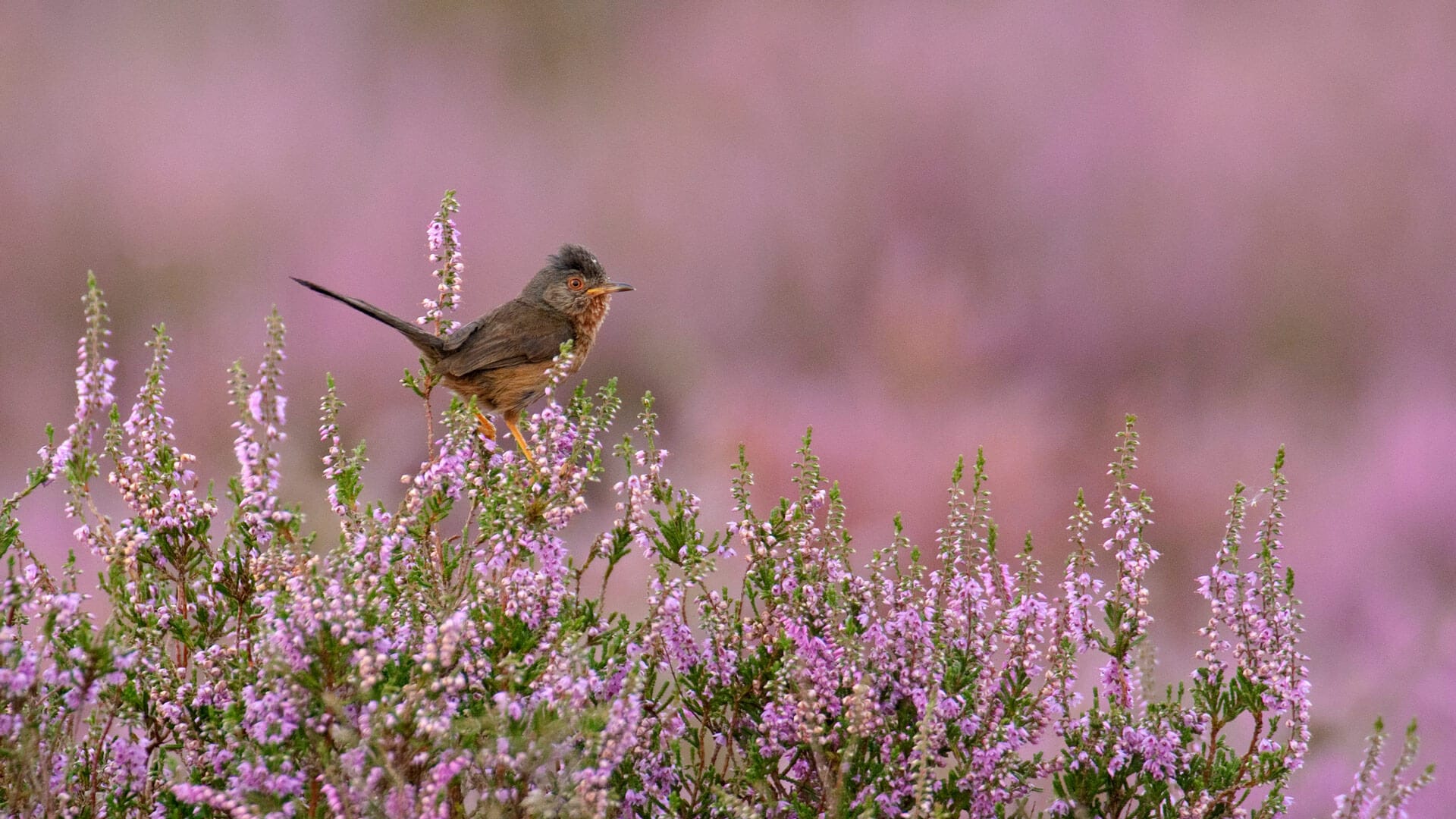
Drawing on decades of experience studying Dorset’s heathland, Dr Lesley Haskins explains why heather habitats are so vital — and why ground‑nesting birds need our protection more than ever.
Have you ever thought what unusual plants heathers are? They grow low on the ground like herbs and grasses, and yet their stems are not soft like theirs, but hard and woody, rather as though they are tiny trees. This presents heathers with something of a problem, for when we stand on them, they snap off and die.
Heathers are actually correctly known as ‘dwarf shrubs.’ Lots of places in the world have habitats made up mostly of dwarf shrubs. The one we have here in Dorset is known as ‘Lowland Heathland’ – and although we are rather used to seeing it and so tend to think it commonplace, it is actually very rare on a global basis. There never was much of it in the first place, and so much of that has now been changed to other things that what little remains is very, very, special indeed!
So, we do need to take great care of it. And because those heathers are so fragile and prone to snapping when stepped on, one of the main ways we can all help is by sticking to the main paths on our heathland walks and not being tempted to widen them by using the edges or make new ones by taking shortcuts. This is not just important for the fragile heathers, it lessens the risk of disturbing the heaths’ several ground nesting birds, or squashing delicate burrows made by sand lizards and ground burrowing bees.
Heathers are also vulnerable in other ways. They have a strong aversion to being fed with any nutrients – giving them any sort of fertiliser causes death and takeover by invasive grasses. So, it is terribly important to always pick up after our dogs – and keep them to the paths too, as those special birds sometimes nest close to the path sides.
And finally, of course, those dwarf shrub heathers are highly flammable, so never ever drop a cigarette end, leave any glass, or be tempted to have a BBQ on or near any heathland. Our heaths are so special and so rare that it deserves to be there to be enjoyed by us forever.
Spring is nesting season on Dorset’s heathlands, where rare birds like nightjars and Dartford warblers raise their young. From March to August, please keep dogs on leads and stay on paths to avoid disturbing vulnerable ground‑nesting wildlife.
Photo Credit Chris Gomersall