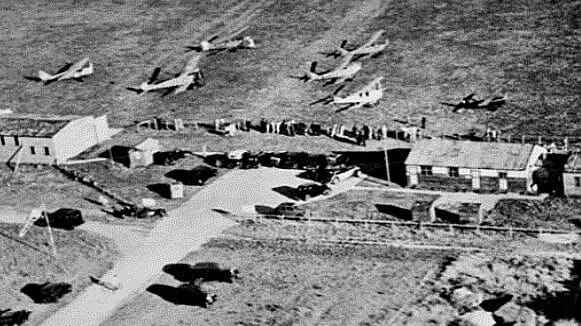
Few passing Somerford roundabout today would guess that the industrial estate to its southeast was once home to Christchurch Airfield — a lively hub of aviation from 1926 to 1964.
It began modestly. Surrey Flying Services first operated from the site, offering five-shilling (25p) pleasure flights that drew curious locals skyward. Francis C. Fisher later leased the fields, flying more than 19,000 passengers before his lease ended in 1932 — an extraordinary achievement for the era. The following year, Sir Alan Cobham’s famous Air Circus attracted a crowd of 8,000, and by 1934 Western Airways had established regular services using a de Havilland Dragon Rapide. You could fly to destinations including the Scilly Isles, Channel Islands, Cornwall, Wales, London and even Paris! It was briefly known as Bournemouth Airport, and there were grand plans for an art-deco terminal building before war arrived.
The airfield’s character changed dramatically during World War II. Requisitioned as RAF Christchurch, it became a centre for radar research, while an Airspeed factory on the site produced Horsa gliders, Airspeed Oxfords and de Havilland Mosquitos. Its location made it ideal for supporting operations along the south coast, and in 1943 it was selected as one of the airfields preparing for the liberation of France.
Post-war, Christchurch remained busy with aircraft production, including the early jets – DeHavilland Vampire, Venom and Sea Vixen as well as the UK’s first post-war airliner, the Airspeed Ambassador. A new Tarmac runway was laid in 1954 to support the de Havilland jet factory, but when the factory closed in 1962, the airfield’s decline was swift. The control tower shut in 1963, and the airfield officially closed the following year. Most buildings were demolished in 1966, though aircraft continued to occasionally use the site until the mid 1970s.
For those who would like to find out more, there is a wealth of information to be found on the Friends of the New Forest Airfields (FONFA) website at www.fonfa.co.uk