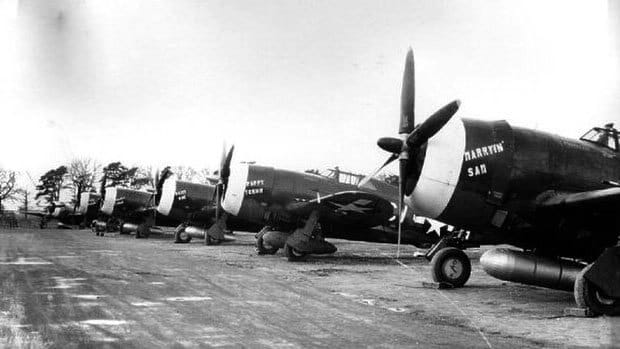
About 1 mile east of Lymington lies the location of an Advanced Landing Ground (ALG) constructed in the summer of 1943 in preparation for D-Day. For security reasons, the USAAF referred to Lymington Station AAF-551. ALGs consisted of temporary runways constructed from a wire mesh strengthened with steel rods and pinned to the turf with steel spikes. Pierced Steel planking was used for aircraft hard standings and marshalling areas. Very few huts were built, with most personnel living in tents or, occasionally, a requisitioned house or farm. Aircraft servicing was done in Blister hangars.
In April 1944 three US squadrons of the 50th Fighter Group arrived. These squadrons were equipped with P47 Thunderbolt fighters and commenced operations at the beginning of May. In addition to fighter sweeps and dive-bombing missions, the Group provided fighter escorts for bombers destroying enemy defences in Normandy. At the end of that month, they started preparations to support the D-Day invasion, and on June 6th and 7th the Group provided fighter cover for the beaches and convoy routes before returning to ground attack missions, attacking bridges, roads, vehicles, railways, trains, gun emplacements, and marshalling yards. The Group moved to France at the end of June. After that, little flying took place, and the site was broken down in the spring of 1945.
Further information about the New Forest airfields can be found by visiting the FONFA Heritage Centre in Bransgore – details at www.fonfa.co.uk